
 EN
EN 
service@hnwpx.com
The principle and application of lightning arresters in power supply systems
Time: 2026年04月29日 Hit:
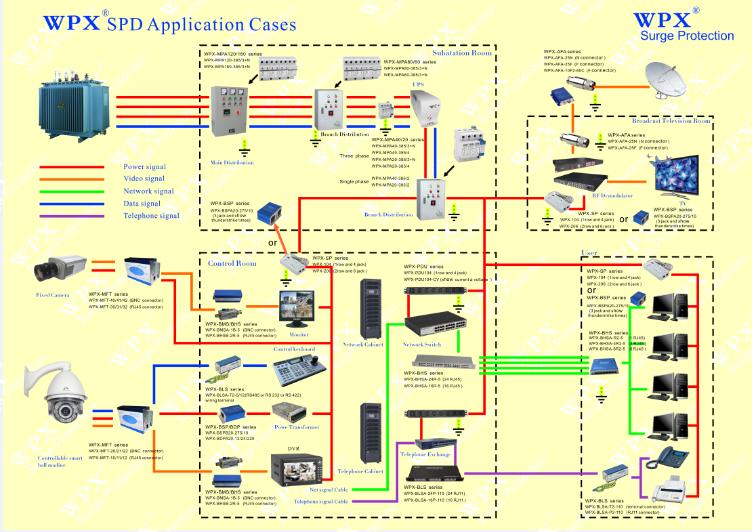
I. Basic Principles of Lightning Protection
Lightning and other strong disturbances cause significant damage to communication systems and result in serious consequences. Lightning protection will become necessary. Lightning consists of high-energy low-frequency components and highly penetrating high-frequency components. It mainly occurs in two forms: one is through metal conduits or grounding wires to directly conduct the damage caused by lightning to equipment; the other is that the lightning electromagnetic pulses in the lightning channel and discharge channel induce the lightning electromagnetic pulses through various coupling methods onto metal conduits or grounding wires, causing surges to damage equipment. The vast majority of lightning damage is caused by this induction. For electronic information equipment, the main hazard comes from the coupling energy of the lightning electromagnetic pulses caused by lightning, which generates transient surges through the following three channels: the metal conduit channel, such as water supply pipes, power lines, antenna feeders, signal lines, and lead wires of aviation obstruction lights, etc., which generate surges; the grounding wire channel, where the earth current counterattacks; and the space channel, where the electromagnetic energy radiated by the electromagnetic group WPX-PTSA-R4-48 is generated.
Among them, the surge in the metal pipeline channel and the ground potential surges in the ground wire channel are the main causes of damage to electronic information systems. The most common form of damage is lightning damage caused on power lines. Therefore, it needs to be given priority as a focus of protection. Since lightning strikes penetrate every corner of the electronic information system, lightning protection will be a systematic project. The core content of lightning protection is discharge and balance.
Discharge involves the release of the energy of lightning and lightning electromagnetic pulses through the earth, and it should follow the principle of hierarchy, that is, to release the excess energy as much as possible and as far away as possible before introducing it into the communication system; hierarchy means weakening the lightning energy by dividing it into different levels according to the established lightning protection zones. The lightning protection zone is also known as the electromagnetic compatibility zone, which divides the environment into several areas based on the different sensitivities of people, objects, and information systems to lightning and lightning electromagnetic pulses: LPZOA zone, in this zone, all objects may be directly struck by lightning, so each object may conduct away all the lightning current, and there is no attenuation of the electromagnetic field in this zone. LPZOB zone, in this zone, objects within the zone may not be directly struck by lightning, but the electromagnetic field in this zone does not attenuate. LPZ1 zone, in this zone, objects within the zone may not be directly struck by lightning, and the current flowing to each conductor is further reduced compared to the LPZOB zone. The attenuation and effect of the electromagnetic field depend on the overall shielding measures. Subsequent lightning protection zones (LPZ2 zone, etc.) should introduce subsequent lightning protection zones if it is necessary to further reduce the guided current and electromagnetic field. The selection of subsequent lightning protection zones should be based on the environmental zone required by the system to be protected and the requirements of the subsequent lightning protection zones. The higher the sequence number of the protection zone, the lower the expected interference energy and interference voltage. In modern lightning protection technology, the setting of lightning protection zones is of great significance, as it can guide us to implement technical measures such as shielding, grounding, and equipotential bonding.
2. Balance means maintaining that no potential difference sufficient to cause damage is generated among the various parts of the system. That is, the potentials of the surrounding environment where the system is located and all the metal conductors within the system remain basically equal during transient phenomena. This essentially relies on equipotential bonding and equal potential connection. A potential compensation system consisting of a reliable grounding system, metal conductors for equal potential connection, and equal potential connectors (surge protectors) can be formed. During the short period when transient phenomena exist, this potential compensation system can quickly establish an equipotential state among all the conductive components within the protected system, including active conductors. Through this complete potential compensation system, an equipotential area can be formed within a short time, with a potential difference of tens of kilovolts possibly existing in the distant area. It is important that there is no significant potential difference among all the conductive components within the area where the protected system is located.
3. The lightning protection system consists of three parts, each of which plays an important role and cannot be replaced. The external protection is composed of lightning arresters, down conductors, and grounding bodies, which can directly channel most of the lightning energy into the ground for discharge. The transitional protection is made up of reasonable shielding, grounding, and wiring, which can reduce or block the induced currents introduced through various intrusion channels. The internal protection is composed of equipotential bonding and overvoltage protection, which can balance the system potential and limit the amplitude of overvoltage.
II. Functions and Technical Parameters of Lightning Arresters
A lightning arrester is also known as an equipotential connector, an overvoltage protector, a surge suppressor, a surge absorber, a lightning protection device, etc. It is used for protection of power lines and is called a power lightning arrester when it is used for lightning protection. Given the current characteristics of lightning damage, lightning protection, especially in the process of lightning rectification, the protection scheme based on lightning arresters is a simple and economical lightning protection solution. The main function of a lightning arrester is to keep the potentials at both ends consistent or limit them within a certain range during transient phenomena, and to transfer the excess energy on the active conductor.
Entering the underground discharge is an important part of achieving uniform pressure and equipotential connection. Some key technical parameters of the lightning arresters: rated working voltage, rated working current, the current-carrying capacity of the specially approved series-parallel power supply lightning arresters. Current-carrying capacity, the ability of the lightning arresters to transfer lightning current, measured in kiloamperes, related to the open-circuit type. Lightning arresters functionally can be classified as lightning strike-proof lightning arresters and induction lightning-proof lightning arresters. Lightning strike-proof lightning arresters are usually used for line protection that may be struck by direct lightning, such as at the boundary between LPZOA and LPZ1 areas. They are tested and indicated with a 10/35μs current waveform to represent their current-carrying capacity. Induction lightning-proof lightning arresters are usually used for line protection that is unlikely to be struck by direct lightning, such as at the boundary between LPZOB and LPX1 areas, and LPZ1 areas. They are tested and indicated with an 8/20μs current waveform to represent their current-carrying capacity response time, the time required for the lightning arresters to control transient phenomena, related to the waveform properties. Residual voltage, the voltage limiting ability of the lightning arresters for transient phenomena, related to the amplitude and waveform properties of the lightning current.
III. Selection of Lightning Arresters
To achieve the desired protective effect with lightning arresters, it is crucial to "properly install the appropriate lightning arresters in the right locations". The selection of lightning arresters is of great significance.
The distribution of lightning current among various facilities within the building is as follows: approximately 50% of the lightning current is discharged into the ground through the external lightning protection devices, while the remaining 50% will be distributed within the metallic components of the entire system. This assessment model is used to estimate the current-carrying capacity of lightning arresters and the specifications of metal conductors at the junctions where equipotential connections are made in the LPAOA zone, LPZOB zone, and LPZ1 zone. The lightning current at this location is a 10/35 μs current waveform. The distribution of lightning current among the various metallic components is as follows: the amplitude of each part of the lightning current depends on the impedance and inductive reactance of each distribution channel. The distribution channel refers to the metallic components that may be assigned to the lightning current, such as power lines, signal lines, water pipes, metal frameworks and other metal pipe-level and other grounds, and generally, their grounding resistance values can be used to roughly estimate. In cases where it is uncertain, it can be assumed that the resistances are equal, that is, the current is evenly distributed among the metal pipelines.
2. When the power line is introduced overhead and the power line may be struck by direct lightning, the lightning current entering the protected area within the building depends on the impedance and reactance of the external line, the discharge branch of the lightning arrester, and the user-side line. If the impedances at both ends are the same, then half of the direct lightning current is distributed to the power line. In this case, a lightning arrester with direct lightning protection function must be adopted.
3. The subsequent evaluation mode is used to assess the lightning current distribution at the junction of the subsequent protection zone in the LPZ1 area. Since the insulation impedance on the user side is much greater than the impedance of the discharge path of the lightning arrester and the external lead-out line, the lightning current entering the subsequent protection zone will be reduced, and no special estimation is required in terms of the numerical value. Generally, the current-carrying capacity of the power supply lightning arrester for the subsequent protection zone should be below 20kA (8/20μs), and high current-carrying-capacity lightning arresters do not need to be used. The selection of lightning arresters for the subsequent protection zone should consider the energy distribution and voltage coordination between different levels. When many factors are difficult to determine, a series-parallel power lightning arrester is a good choice. Series-parallel is a concept proposed based on many application scenarios and protection range levels in modern lightning protection (compared to traditional parallel lightning arresters). Its essence is the effective combination of multi-level discharge devices and filter technology through energy coordination and voltage distribution. The characteristics of series-parallel lightning arresters are as follows: They are widely used. They can be applied in a conventional manner and are also suitable for places where it is difficult to distinguish the protection areas. The voltage division and delay effect of the induced decoupling device under transient overvoltage can help achieve energy coordination. Slowing down the rising rate of transient interference to achieve low residual voltage, long service life and fast response time.
4. The selection of other parameters for the lightning arrester depends on the level of the lightning protection zone where each protected object is located. The working voltage should be based on the rated voltage of all components installed in the primary circuit. For series-parallel type lightning arresters, attention should also be paid to their rated current.
5. Other factors affecting the distribution of current in the electronic line: A decrease in the grounding resistance at the transformer terminal will increase the current distributed in the electronic line. An increase in the length of the power supply cable will reduce the current distributed in the power line and result in a balanced current distribution in several conductors. An excessively short cable length and an excessively low neutral line impedance will cause current imbalance, thereby causing common-mode interference. Connecting multiple users to the power supply cable in parallel will reduce the effective impedance, leading to an increase in the distributed current. In a meshed power supply state, the temporary lightning current mainly flows into the power line, which is the reason why most lightning damages occur in the power line.
IV. Installation of Lightning Arresters
1. The power lines should be protected in multiple levels. The multiple-level protection is based on each lightning protection zone as a layer, gradually weakening the lightning energy (energy distribution), so that the voltage limits at each level can cooperate with each other, ultimately limiting the overvoltage value within the insulation strength of the equipment (voltage coordination).
In the following situations, multi-level protection becomes necessary: when a certain level of lightning arrester fails or a certain path of the lightning arrester fails. When the residual voltage of the lightning arrester does not match the insulation strength of the equipment, and when the length of the cable within the building is relatively long.
2. In almost all cases, the cable protection should be divided into at least two or more levels. The same-level lightning arresters may also include multiple levels of protection (such as series-parallel lightning arresters). To achieve effective protection, corresponding lightning arresters can be set at the interface of each lightning protection zone. The lightning arresters can target individual electronic devices or a space containing multiple electronic devices. All wires passing through the usually shielded lightning protection zone should be equipped with lightning arresters simultaneously when crossing the interface of the lightning protection zone. Additionally, the protection range of the lightning arresters is limited. Generally, the protection effect will deteriorate when the distance between the lightning arresters and the equipment lines exceeds 10 meters, because there are oscillating voltages caused by reflections on the cables between the lightning arresters and the protected equipment, and their amplitudes are proportional to the line length and the load impedance.
3. In the multi-level protection of power supply devices, if the energy distribution is not properly managed, more lightning energy may enter the protected area. This requires that the lightning arresters should be selected according to the aforementioned evaluation model. Generally, lightning arresters have the characteristic that the larger the lightning current passing through, the higher the residual voltage. After energy distribution, the lightning current flowing through the next-level lightning arrester is extremely small, which is conducive to voltage limitation. Note that it is dangerous to simply select a low-response voltage lightning arrester as the final protection without considering voltage coordination.
The key to achieving energy distribution and voltage coordination lies in utilizing the inductive reactance of the cable between the two-level lightning arresters. The inductive reactance of the cable has a certain effect of hindering current and dividing voltage, causing the lightning current to be more distributed to the previous stage for discharge. Generally, the length of the cable between the two-level lightning arresters should be around 15 meters, which is suitable for situations where the protective ground wire is closely laid with other cables or is within the same cable. The length of the branch lines on the cable has an impact on the required length of the cable. When the protective ground wire is at a certain distance (>1m) from the protected cable, the requirement for the cable length is greater than 5 meters. In some cases where it is not suitable to use the cable itself as a decoupling measure, such as when the interface between the two-level lightning protection zones is close or the cable length is short, a dedicated decoupling device can be used. In this case, there is no distance requirement.
4. Decoupling devices are an important measure for achieving energy distribution and voltage coordination. The following materials can be used as decoupling devices: cables, inductors, and resistors.
The series-parallel power surge protector is a combination form of a surge protector that takes into account energy distribution and voltage coordination, and uses filters as decoupling devices. It is suitable for applications in various scenarios.
5. In some extreme cases, installing a lightning arrester may actually increase the possibility of equipment damage. Such situations must be avoided; when they occur, the lightning arrester protects several lines, and in one of these lines, the lightning arrester fails or has a slow response speed. This may cause common-mode interference to transform into differential-mode interference and damage the equipment. This requires implementing multi-level protection and paying attention to the maintenance of the lightning arrester. Without considering the lightning protection zone, energy coordination, and voltage distribution, and installing the lightning arrester randomly, for example, merely installing a lightning arrester at the front end of the equipment, due to the lack of pre-stage protection, the powerful lightning current will be attracted to the front end of the equipment, causing the residual voltage of the lightning arrester to exceed the insulation strength of the equipment. This requires that the lightning arrester must be installed according to the hierarchical principle.
6. In some other cases, incorrect installation will result in the equipment not being effectively protected. Long connection lines for lightning arresters, and high voltages caused by inductive reactance on the connection lines when the lightning arresters are in operation, will still pose dangerous voltages to the equipment. This problem is more obvious in the application of the final-stage lightning arresters. The solution to this problem is to use shorter connection lines and also to use two or more separate connection lines to distribute the magnetic field intensity and reduce voltage drop. Using a single thickened connection line is of no effect. When necessary, the wiring of the protected lines can be changed to be closer to the equipotential connection bus (grounding point) to reduce the length of the connection lines.
The output and input lines of the lightning arrester, as well as the grounding line, are laid close together and side by side. This situation has a more serious impact on series-parallel lightning arresters. When the output line (protected line) and input line (unprotected line) of the series-parallel power lightning arrester are laid close together, transient surges will be induced in the output line, although the intensity is smaller than before, it can still be dangerous. The solution to this problem is to lay the input line, grounding line and output line separately or vertically, and try to reduce the length of the parallel laying as much as possible and increase the laying distance.
The grounding line of the lightning arrester is not connected to the protection ground of the protected equipment, that is, a separate lightning protection grounding is adopted. This will cause dangerous voltages to exist between the protected line and the equipment protection ground during transient times. The solution to this problem is that the grounding of the lightning arrester should be connected to the equipment protection ground WPX-PTSA-R4-48.

